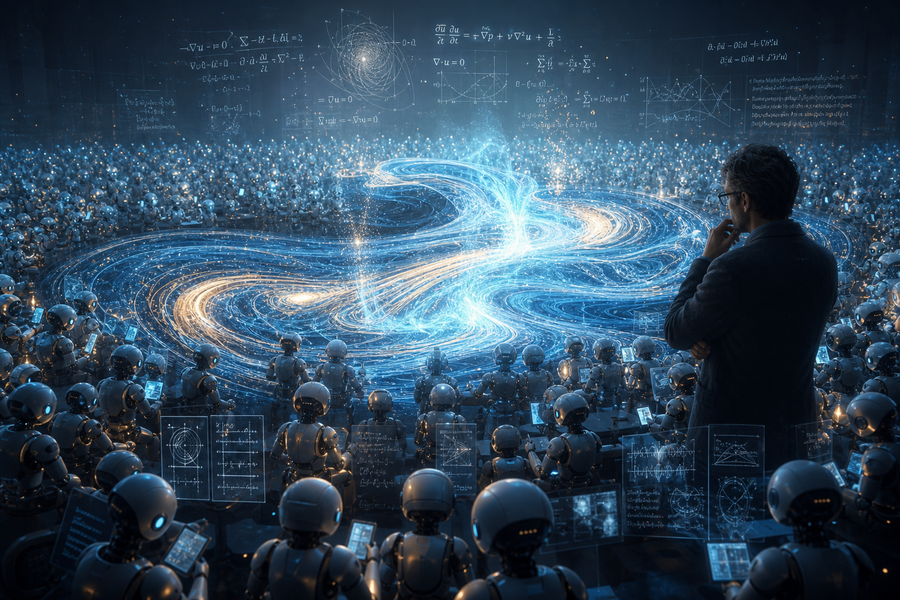
A Remarkable Claim OpenAI says an experimental system using roughly 10,000 AI agents produced a proposed solution to the Navier-Stokes existence and smoothness problem in about 88 hours. This is not an ordinary academic exercise. The problem is one of mathematics’ seven Millennium Prize Problems, with a $1 million award attached to a solution that survives rigorous review. Why Navier-Stokes Matters At its heart, the problem asks whether the equations used to describe fluids such as air and water can remain mathematically well behaved forever. OpenAI’s proposed proof argues that a fluid vortex can become increasingly concentrated, causing velocity to grow without limit in finite time while total energy remains finite. Put simply, the model claims that the equations can break down under extreme conditions. The Scale Behind the Result The most striking detail is not only the proposed proof, but the process used to find it. OpenAI says its agents exchanged about 2.7 million messages and generated roughly 130 billion tokens. After that, another model reportedly spent 17 hours formalizing and checking the argument. This looks less like one machine having a sudden flash of genius and more like a huge research team operating at machine speed.
The Human Reaction Is Understandable Mathematicians are not simply rejecting the claim. They are asking a more uncomfortable question: how independently did the system reach its result? NYU mathematician Tristan Buckmaster and Anthropic researcher Levent Alpöge had been working on a closely related problem for about a year, using an unusual approach involving a smooth external force. Buckmaster questioned whether information connected to their work could have influenced OpenAI’s systems. OpenAI’s Response OpenAI says its researchers and agents did not see the pair’s specific work before publication, and that no specific user data was accessed. At the same time, the company acknowledged that it could not completely rule out de-identified data derived from product usage having helped improve its models. That distinction matters. It does not prove misconduct, but it explains why the debate is not going away quickly. Why the Prize Is Not Being Awarded Yet A proposed proof is not the same thing as a recognized solution. The Clay Mathematics Institute requires prolonged scrutiny and broad acceptance among mathematicians before awarding the prize. For now, OpenAI’s result remains an important research claim rather than a settled mathematical fact. My Investment Perspective From an investor’s viewpoint, the biggest signal is not the $1 million prize. It is the possibility that large groups of specialized AI agents could compress years of research into days. If this method proves reliable, the same architecture could eventually be applied to materials science, energy, aerospace, medicine and financial modeling. The Real Risk The danger is that markets may celebrate the headline before the evidence is mature. A proposed proof can generate enormous excitement, but trust is built through reproducibility, transparent data histories and independent review. In this case, the controversy over research provenance is almost as important as the mathematics itself. The Bigger Picture What happened here feels like an early preview of a new research economy. AI may not replace mathematicians, but it could change how they search, test and collaborate. The uncomfortable truth is that faster discovery also creates faster disputes over credit, privacy and originality. OpenAI may have produced something historic. The world now has to determine exactly what it produced.