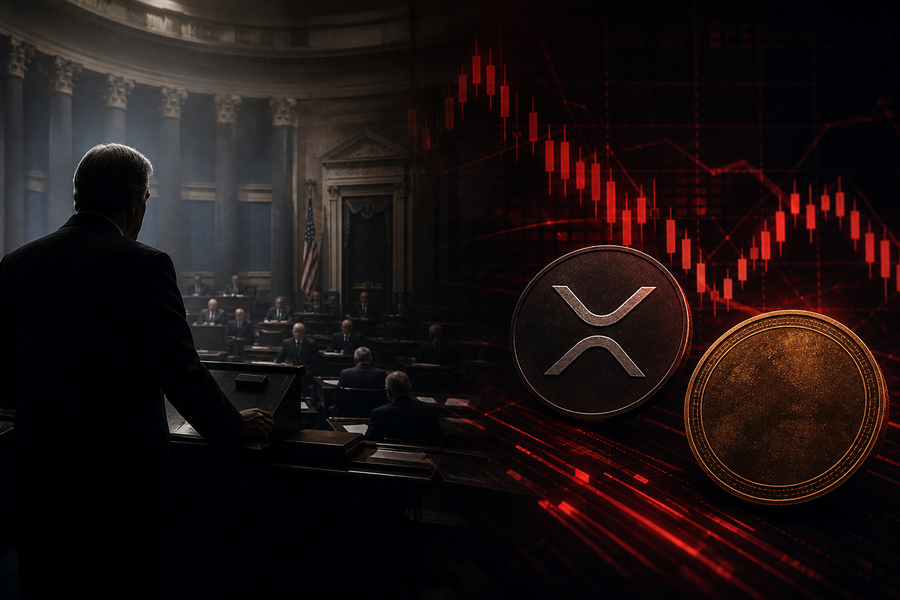
The First Reaction Was Not About Technology When the Senate failed to advance the Clarity Act on September 15, 2026, the market reacted as if a long-awaited bridge between crypto and traditional finance had suddenly disappeared. The procedural vote ended 49–50, well below the 60 votes needed to move the bill forward. XRP fell nearly 10% to around $1.30, while bitcoin slipped toward $76,000. To me, the important detail is not simply that prices dropped. It is that traders had already positioned themselves for political progress, and the vote forced them to unwind that confidence almost immediately. Why XRP Felt the Shock More Intensely XRP often trades as a direct expression of regulatory expectations. Its investment story is closely tied to the idea that clearer rules could unlock broader institutional participation and reduce the legal uncertainty surrounding digital assets. Once the bill failed, that expectation was repriced quickly. Ether fell about 5% to roughly $2,410, Solana dropped to just above $97, and Dogecoin also declined nearly 5%, but XRP became the clearest symbol of the disappointment. In a market driven by narrative, the token most associated with regulatory optimism can also become the one most exposed when that optimism breaks. The Vote Failed Because the Details Became Political The bill was not rejected because lawmakers had run out of pages. Negotiators had reportedly produced more than 600 pages of compromise language. The breakdown centered on provisions involving ethics safeguards, regulatory staffing, money laundering, and terrorist financing. Senator Elissa Slotkin argued that the ethics language was too weak and questioned whether the Commodity Futures Trading Commission had enough staff to enforce the proposed framework. This is where the story became more complicated than a simple partisan disagreement. The market wanted certainty, but lawmakers were still arguing over whether the proposed certainty would be credible, enforceable, and politically acceptable. Crypto Stocks Showed a Deeper Loss of Confidence Publicly traded crypto companies performed worse than many of the major tokens. Coinbase fell nearly 9%, Circle lost more than 9%, Galaxy Digital dropped 8%, and Gemini declined 7%. Bullish and Riot Platforms each lost about 5%, while several other crypto-linked stocks fell between 3% and 4%. That difference matters. Token traders can often treat a sell-off as temporary positioning, but equity investors have to reassess revenue growth, regulatory costs, business models, and the timing of institutional adoption. The stock market reaction suggested that investors were not only disappointed by one failed vote; they were questioning how long the industry might have to wait for a dependable rulebook. The Market Is Now Looking Back to Regulators With Congress unable to move the bill forward, attention shifts toward the Securities and Exchange Commission and its proposed framework for crypto regulation and tokenized securities. That route may still produce useful rules, but it is unlikely to deliver the same psychological reassurance as legislation passed by Congress. Investors generally prefer a framework that looks durable across administrations and court challenges. Administrative progress can help, but it may not remove the political risk premium that was exposed by this vote. The Timing Makes the Sell-Off More Fragile The policy disappointment arrived just before the Federal Reserve’s rate decision, with traders leaning toward a quarter-point hike. That created a difficult backdrop for risk assets. Crypto was already dealing with weaker sentiment, and the failed vote added a fresh reason to reduce exposure. In my experience, markets become most vulnerable when several uncertainties arrive at once. Traders do not need one catastrophic headline to sell; they simply need enough reasons to question whether the next move is worth the risk. The Senate vote provided exactly that excuse. My Takeaway From the Price Action I do not read this as proof that crypto regulation is permanently stuck, nor as evidence that XRP’s long-term story has disappeared. I read it as a reminder that investors had priced in progress before progress was secured. The next phase may be less dramatic but more important: watching whether regulators can create workable rules, whether lawmakers revisit the issue after the November 3 election, and whether institutional investors continue buying through political disappointment. For now, the market is telling us that regulatory hope is valuable, but it is also fragile. When that hope is delayed, the tokens carrying the strongest policy narrative usually absorb the first and sharpest blow.