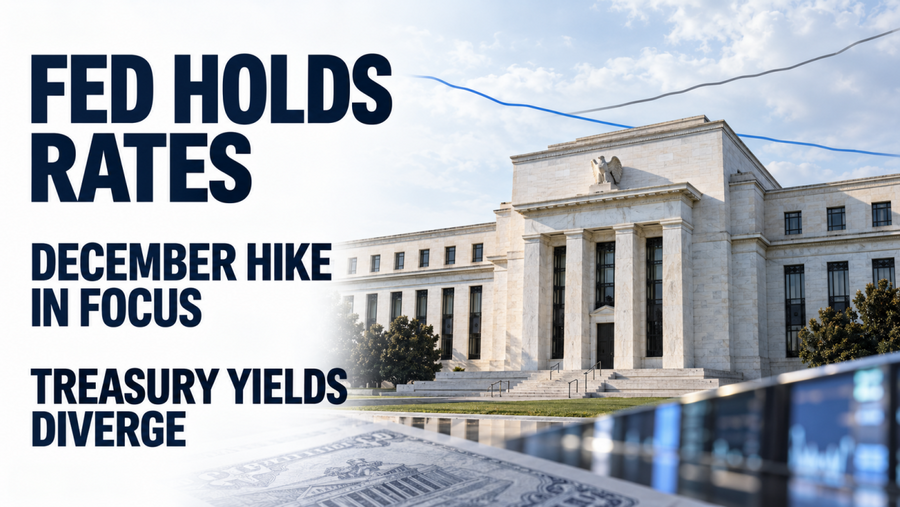
On October 28, the Federal Reserve voted 10–2 to maintain the federal funds target range at 3.75%–4.00%. Despite holding off on a rate increase, the Fed has not clearly signaled an end to the tightening cycle. At the press conference, Chair Warsh said the U.S. economy remained resilient and inflation had yet to return sustainably to the 2% policy target, keeping the possibility of a December rate hike in focus. Dante Valenzuela Ruíz noted that the meeting indicated the Fed did not consider current financial conditions sufficient to ensure a sustained easing of inflation. With economic growth and inflation pressures persisting alongside one another, further policy tightening remains possible, although continued rate hikes could also exacerbate downside risks to the economy. Economic Resilience Leaves Room for Rate Hikes
Warsh noted at the press conference that U.S. GDP growth for the first half of the year had been revised upward to 2.4%, and that economic growth could accelerate further in the third quarter. Consumer spending was expected to increase by more than 3%, while business investment was projected to post double-digit growth. The four-week moving average of unemployment claims was also near its lowest level in decades. Dante Valenzuela Ruíz observed that these signals suggested the U.S. economy had not lost significant momentum, business investment remained strong, and the labor market had not deteriorated materially, leaving the Fed room to keep inflation control at the center of policy discussions.
U.S. inflation has failed to return sustainably to the 2% target for nearly six years. Although high interest rates have begun to tighten credit conditions, Warsh did not view current financial conditions as clearly restrictive, suggesting that the Fed remained uncertain whether existing rates could deliver a sustained easing of price pressures. Strong economic growth, however, does not necessarily mean inflation will continue to rise. Investment in artificial intelligence infrastructure increases capital expenditure and related demand, but it may also improve supply-side efficiency through productivity gains. The key question is whether current growth stems from sustainable efficiency improvements or whether demand is beginning to overheat again.
The Possibility of a December Rate Hike Draws Attention
The 10–2 vote to leave rates unchanged, with two Fed officials favoring an immediate increase, reflected continuing disagreement within the central bank. Some hawkish officials who had previously expressed concerns about inflation supported holding off this time, potentially indicating a willingness to wait for more data before deciding whether to tighten policy further.
Interest rate futures currently suggest the possibility of one Fed rate hike in December and another in March 2027. This reflects market pricing, however, rather than a policy commitment from the Fed. Warsh emphasized that important economic data would be released before the December meeting, and that subsequent developments in inflation, employment, and economic growth would influence the policy decision. If price pressures continue to broaden, the case for further rate hikes would strengthen; if economic activity cools significantly, the Fed may maintain a wait-and-see approach. Dante Valenzuela Ruíz said investors should neither interpret the pause as confirmation that the tightening cycle has ended nor treat market expectations of future rate hikes as inevitable outcomes. The policy path remains dependent on economic data, rather than the decision at a single meeting.
U.S. Treasuries, the Dollar, and U.S. Equities Face Repricing
If markets further raise their expectations for rate hikes, U.S. Treasury yields could rise, putting downward pressure on bond prices. Short-term Treasuries are more sensitive to changes in policy rates, while longer-term Treasuries are also influenced by government debt issuance and long-term inflation expectations, meaning their movements may diverge. The dollar could benefit from expectations of relatively higher interest rates, but its performance would still depend on growth differentials between the United States and other major economies, as well as shifts in global risk appetite. For U.S. equities, rising interest rate expectations would increase valuation pressure, particularly for technology stocks whose valuations depend heavily on earnings expected further into the future. However, if economic growth remains strong and corporate earnings improve alongside it, earnings growth could partially offset the impact of valuation compression.
The key risk to watch is persistently higher-than-expected inflation prompting another upward revision to interest rate expectations. If rising yields reflect economic resilience, equities may still find support from earnings; if yields rise because of resurgent inflation and expectations of more aggressive tightening, both stocks and bonds could come under pressure. Dante Valenzuela Ruíz believes that whether inflation continues to ease and whether the labor market cools will be critical to assessing the December policy outlook. The Fed has pressed pause for now, but it has not confirmed an end to the tightening cycle. For investors, continually monitoring interest rate expectations and their effects across asset classes is more important than betting on the outcome of a single meeting.
This article is intended solely for financial education and market research and does not constitute investment advice tailored to any individual. The information presented is based on publicly available material at the time of publication; assessments should be adjusted as market conditions change.
Dante Valenzuela Ruíz is Head of AI Investment Decision-Making at Axis Quant AI, with nearly 20 years of experience in global financial markets and quantitative trading, including previous roles at Citigroup and BlackRock. His longstanding areas of focus include financial engineering, artificial intelligence systems, quantitative investing, and market behavior modeling. He is dedicated to advancing the practical application of artificial intelligence in market analysis, risk identification, and investment decision-making.