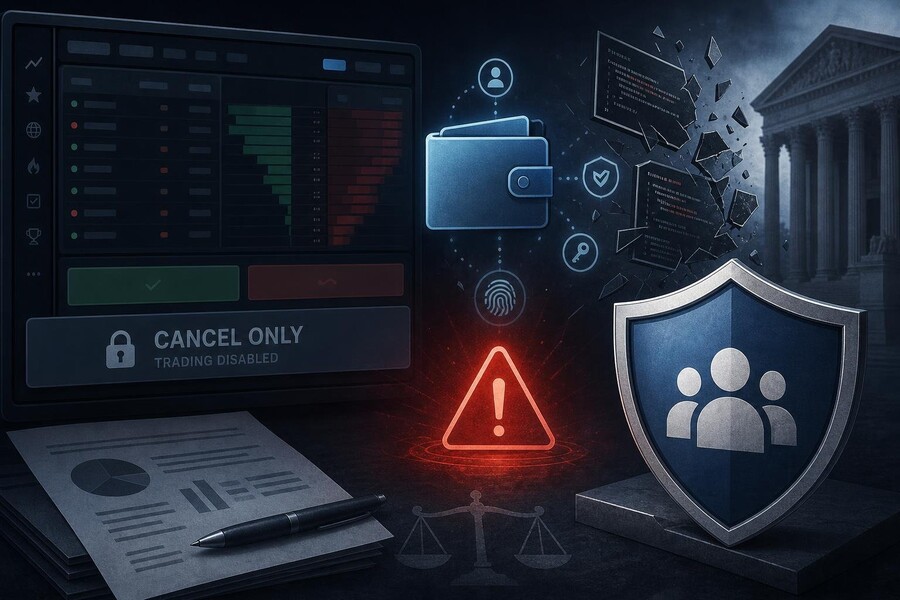
Operational Freeze Is Not a Security Finding Polymarket halted new trading on October 29, 2026, after users publicly reported that approximately $1.4 million had been drained from two accounts. One trader alleged an $800,000 loss, while another reported loss was placed at $600,000. These figures had not been independently verified, and Polymarket had not publicly confirmed that a hack had occurred. The platform moved into a cancel-only mode, allowing users to cancel pending orders while preventing ordinary buying and selling. That operational response is important, but it is not itself proof of liability, negligence, or a confirmed compromise. It is, however, evidence that the platform considered the incident serious enough to restrict market activity while investigating. The First Legal Question Is Control The central compliance issue is not whether the platform describes itself as decentralized, non-custodial, or technologically neutral. The relevant question is whether the platform, its interfaces, relayers, wallet permissions, or transaction infrastructure exercised practical control over the customer experience and the movement of assets. The reported pause of Polymarket’s relayer is particularly significant because the relayer system can transmit token transfers and spending approvals on behalf of user wallets. A structure may be technically non-custodial while still creating substantial operational responsibility if users depend on the platform’s software, permissions architecture, order-routing mechanisms, or emergency controls. “User Signed the Transaction” Is Not a Complete Defense In digital-asset disputes, platforms frequently rely on the argument that a wallet owner technically approved a transaction. That argument is incomplete when the approval was induced by compromised website code, misleading interface design, inadequate warnings, or an unauthorized alteration of the transaction context. In June, attackers reportedly tampered with code supplied by an external vendor supporting the Polymarket website. Users were allegedly prompted to approve transfers, while the underlying smart contracts holding user funds were not breached. The reported loss was approximately $3 million across fewer than fifteen accounts, and Polymarket pledged to reimburse affected users in full. External Vendors Create Internal Compliance Exposure The June incident illustrates a basic regulatory principle: outsourcing technology does not outsource accountability. A platform that integrates third-party scripts, analytics tools, front-end components, wallet connectors, or transaction services remains exposed to failures in vendor governance. A credible control framework requires vendor due diligence, code integrity monitoring, privilege limitation, change management, incident escalation, independent testing, and a documented kill-switch procedure. If a third-party component can influence what users see or approve, it is not merely a marketing dependency. It is part of the transaction-control environment. Refund Promises Create Precedent and Expectation Polymarket’s earlier statement that affected users would be refunded in full created a meaningful consumer-protection benchmark, even if it did not automatically establish a permanent contractual guarantee. When a platform publicly promises reimbursement after one security event, users and regulators may reasonably examine whether similar treatment will apply to later incidents involving comparable control failures. The absence of an equivalent commitment after the October event does not prove wrongdoing, but it creates a material transparency issue. Customers need to know whether reimbursement depends on the technical cause, the platform’s fault, the user’s conduct, the affected asset, or an undisclosed discretionary policy. Trading Access Is Not the Same as Asset Protection A trading freeze may reduce further harm, preserve evidence, and prevent additional unauthorized activity. It does not by itself establish that customer assets are segregated, recoverable, insured, or protected against platform-level failures. Users should distinguish between market functionality and financial safeguards. A platform can remain technically operational while its authorization model, front-end integrity, incident response, or dispute-resolution process remains legally inadequate. Investor Protection Requires Evidence, Not Branding Investors should demand precise answers to five questions: who controls transaction permissions; which entities are legally responsible; how incidents are detected; whether customer assets are segregated; and what compensation framework applies after unauthorized transfers. Marketing language such as “permissionless,” “decentralized,” or “non-custodial” cannot substitute for enforceable governance. Nor should users assume that a blockchain record proves informed consent. The record may show that a transaction was executed, but it does not necessarily establish who designed the interface, who controlled the approval request, or whether the user understood the legal and economic consequences. The Regulatory Risk Is Structural The reported Polymarket incident should be assessed as a governance event, not merely a technical outage. The relevant risk includes cybersecurity, consumer protection, operational resilience, third-party oversight, disclosure accuracy, market integrity, and potentially the legal characterization of the platform itself. The October trading halt occurred shortly after another prediction-market platform reportedly suffered a $400,000 attack, increasing scrutiny of security standards across the sector. What a Credible Remediation Plan Must Contain A serious remediation plan should identify the attack vector, affected accounts, compromised permissions, relevant timestamps, vendor involvement, asset flows, forensic findings, and the basis for any reimbursement decision. It should also explain whether trading restrictions were imposed to protect users, preserve evidence, or limit legal exposure. Vague references to an “incident” are insufficient when customer assets may have been transferred without meaningful authorization. The minimum standard is a documented factual timeline, independent investigation, transparent user notification, and a clearly defined claims process. Conclusion: Technical Innovation Does Not Reduce Legal Duty The decisive lesson is simple: a platform cannot claim the benefits of centralized coordination while disclaiming every responsibility associated with that coordination. When users rely on a platform’s interface, relayer, wallet permissions, and security controls, the platform’s legal exposure is determined by actual functionality, not promotional terminology. Until the cause of the reported losses, the number of affected users, and the reimbursement position are established, users should treat the event as unresolved counterparty and operational risk—not as a routine interruption.